

Lifecycle Strategy Is an Operating System, Not a Campaign
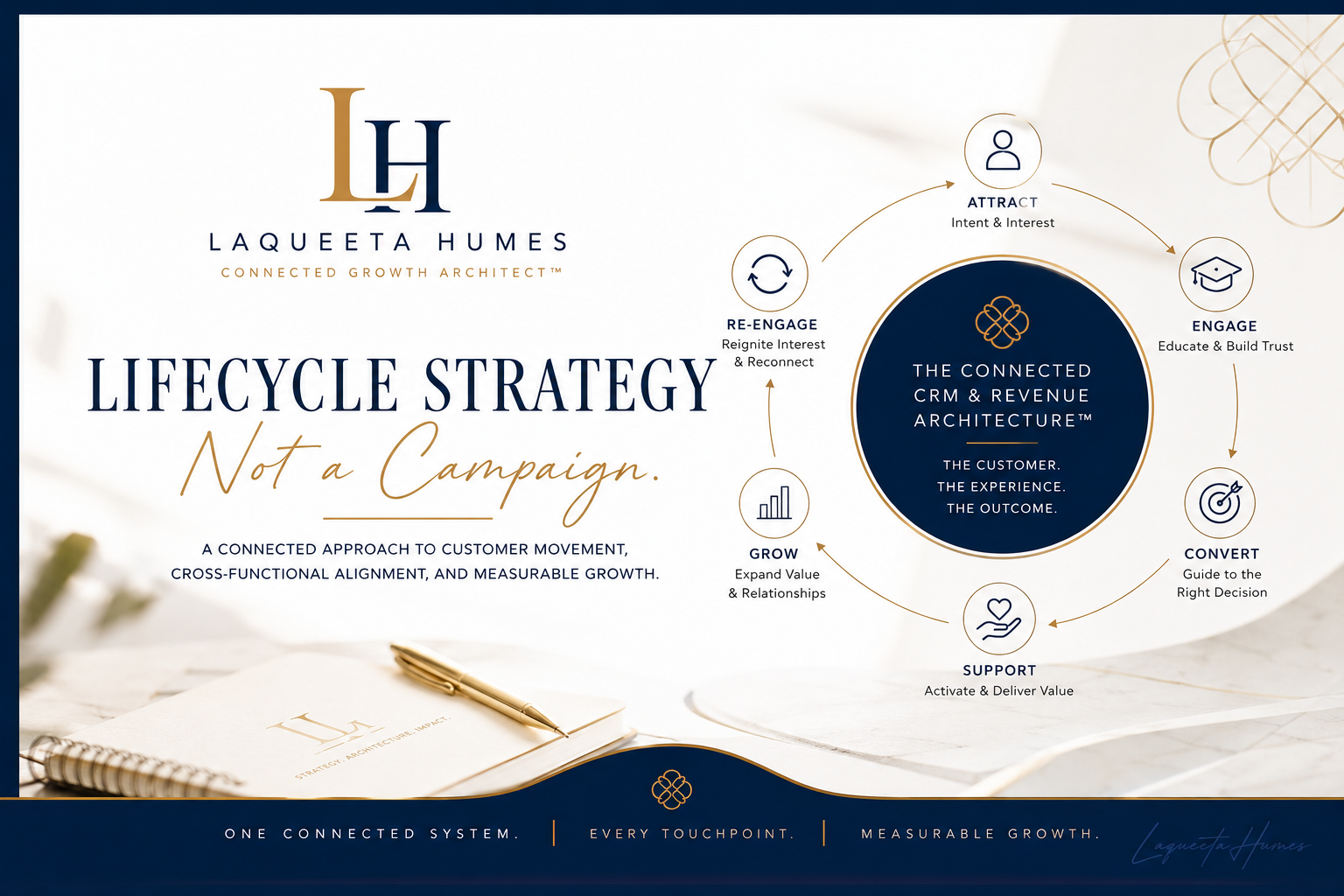
How I connected business goals, customer movement, CRM, cross-functional handoffs, experimentation, AI, and executive decision-making inside a complex growth environment
by Laqueeta Humes
Lifecycle strategy is often reduced to a sequence of communications.
A welcome email. A reminder. A sales task. A retention campaign.
But a true lifecycle strategy is not a campaign calendar. It is the operating system that determines how a person moves through the business, what the organization knows about them, what should happen next, which team owns that action, and how leadership knows whether the system is working.
I learned this while designing lifecycle, CRM, enrollment, marketing, and revenue workflows inside a complex, multi-partner healthcare environment.
The organization did not serve one audience under one brand. It supported prospects, members, brokers, enrollment specialists, customer-service teams, sales representatives, clinical resources, affiliate partners, and white-label organizations.
Each group needed different information, different branding, different timing, and different levels of support.
The challenge was not sending more communications.
The challenge was keeping the connective tissue between customer behavior, CRM data, marketing, sales, service, product, technology, billing, and leadership intact.
That became the foundation of my Connected CRM & Revenue Architecture™ approach.
The business problem was larger than marketing
The customer journey included several moments of intent and several opportunities for friction.
A person could request information, begin an application, schedule a consultation, receive a recommendation, pause during enrollment, complete the process, or require support after becoming a member.
At the same time, that person could belong to a specific affiliate, association, employer, broker, or white-label partner.
A single generic nurture sequence could not account for all of that complexity.
The system needed to understand:
Who the person was
Which brand they expected to see
What product they were considering
Where they had stopped
What information they still needed
Whether another platform or team was already communicating with them
Which department was best equipped to respond
Whether they should continue receiving marketing at all
It also had to prevent the organization from creating new problems while trying to improve conversion.
A marketing reminder could become harmful if a member had already enrolled.
A sales task could become useless if it did not include the customer’s history and reason for escalation.
A billing issue could be misdiagnosed as a lack of interest.
A technical problem could create the appearance of weak demand.
A high open rate could hide a broken application experience.
Lifecycle strategy had to connect all of those realities before any channel could be optimized.
Start with the business outcome, not the message
My first step was to define the decision the business needed to make.
The goal was not simply to send follow-up communications to incomplete applicants.
The goal was to help qualified people take the appropriate next step while creating a reliable, measurable handoff to the correct team.
That meant defining outcomes at four levels.
The customer outcome
The person should understand what to do next and receive the right level of help.
That could mean continuing an application, booking a consultation, resolving an access problem, completing a required step, or receiving an answer from a qualified human.
The business outcome
The organization wanted stronger consultation volume, application completion, qualified opportunities, enrollment progression, and revenue visibility.
The operational outcome
The process needed to reduce manual routing, duplicate outreach, incomplete data, unclear ownership, and spreadsheet-dependent work.
The risk outcome
The journey had to preserve consent, compliance, brand integrity, privacy, deliverability, and partner trust.
This distinction mattered because a channel metric could improve while the larger system became worse.
More clicks are not a success if sales cannot respond.
More appointments are not a success if the audience is unqualified.
More automation is not a success if customer service receives an avoidable surge in complaints.
The business outcome had to remain larger than the communication.
Choose the starting group intentionally
I did not begin with every record in the CRM.
I started with a high-intent group that had already demonstrated interest but had not completed the desired action.
That audience had three advantages.
First, the business could clearly define what progress looked like.
Second, the point of friction could be investigated.
Third, the next-best action could be tailored to the person’s behavior rather than assumed from a broad demographic segment.
The audience was then separated by meaningful business conditions such as:
Lifecycle stage
Product interest
Partner or white-label affiliation
Engagement behavior
Appointment status
Enrollment status
Eligibility or compliance status
Need for human assistance
The most important segmentation decision was not always who should receive a message.
Sometimes it was who should be intentionally suppressed.
People who were already enrolled, no longer eligible, not true leads, associated with another primary contact, or already receiving platform-led communication needed to be excluded from acquisition nurture.
In the underlying workflow design, suppression logic was used to prevent enrolled customers, secondary contacts, and manually disqualified records from receiving inappropriate outreach.
Suppression is part of the customer experience.
It protects relevance, trust, deliverability, sales capacity, and the integrity of the lifecycle.
White-labeling is part of the architecture
In a partner ecosystem, white-labeling cannot be treated as a design request added at the end.
It affects the data model, customer expectation, routing, ownership, content, links, support experience, and reporting.
Before launching a journey, I needed to determine:
Which audience required partner-specific branding?
Was the experience co-branded or fully white-labeled?
Did that partner have different product, support, or routing rules?
Which team owned issues affecting the partner relationship?
Which communications required partner approval?
Which performance results needed to be reported by brand or source?
The scalable answer was not to duplicate the entire lifecycle for every organization.
The answer was to create one governed architecture that could recognize the partner context and dynamically deliver the appropriate brand, destination, owner, and experience.
My work included white-label and co-branded communications using dynamic brand, product, owner, scheduling, pricing, enrollment, and partner information. It also included partner content systems, sales enablement, and reporting structures designed for a multi-organization ecosystem.
That allowed the business to scale personalization without multiplying operational risk.
Document the current state before designing the future state
Before redesigning the journey, I documented what was already happening.
The purpose of current-state documentation is not to create a perfect diagram.
It is to expose where the business is making assumptions, where teams are operating from different definitions, and where a future change could disrupt something that is already working.
A platform such as Confluence can hold:
The current-state journey
The future-state journey
Lifecycle definitions
Ownership rules
Business requirements
Decision history
Governance standards
Approved language
Reporting definitions
A platform such as Jira can track:
Integration dependencies
Missing events
Data defects
Form failures
Workflow defects
Field-mapping issues
Release requirements
Quality-assurance findings
A platform such as Trello can help business teams visualize work moving through:
Discovery
Requirements
Design
Build
Quality assurance
Launch
Monitoring
Optimization
Final decision
The specific tool matters less than the operating discipline.
Every stakeholder should be able to answer:
What are we trying to accomplish?
Who is affected?
What is changing?
What is blocked?
Who owns the next action?
What decision was made?
What evidence supported the decision?
What happens if the system fails?
This documentation becomes the connective tissue between teams.
It allows product, technology, marketing, sales, service, billing, and leadership to operate from one shared version of reality.
Design lifecycle stages around decisions
Lifecycle stages should not exist simply because a CRM requires dropdown values.
Every stage should answer four questions:
What has the person done?
What do they need now?
Who owns the response?
What evidence allows them to move forward?
The journey I designed moved through broad states of:
Initial intent
Evaluation
Assisted decision-making
Application progress
Completion
Activation
Ongoing support
Re-engagement
Final disposition
The exact labels mattered less than the clarity of the rules behind them.
At each stage, I defined:
The qualifying signal
The intended customer outcome
The next-best action
The responsible team
The handoff requirement
The suppression conditions
The success measure
The escalation condition
For example, a person who needed education belonged in a different experience from someone who had requested human help.
A person who encountered a technical barrier needed product or service intervention, not more persuasion.
A person who reached a payment or agreement step needed operational support, not a generic marketing reminder.
A person who completed enrollment needed immediate suppression from acquisition nurture and a clean transition into the member experience.
The stage was not simply a status.
It was a decision point.
The underlying journey included a protected platform-led recovery period, a later CRM-led nurture phase, multiple communication channels, and final disposition categories to preserve list health and reporting accuracy.
Create handoffs that teams can act on
A handoff is not complete because a CRM task was created.
The receiving team needs enough context to act without reconstructing the person’s entire history.
A useful handoff should make the following clear:
Who the person is
Where they are in the lifecycle
What meaningful action they took
Why the handoff was created
Which partner or white-label experience applies
What product or service they are considering
What problem, objection, or need has been identified
What communications they have already received
What the recommended next action is
How quickly the team should respond
What the receiving team must return to the CRM after acting
This final point is critical.
The handoff must be closed.
Sales, service, billing, or another team should return an outcome, disposition, next date, resolution status, or updated stage.
Without that feedback loop, the CRM becomes a task generator rather than an intelligence system.
When should the system notify each team?
The purpose of automation is not to remove people from the process.
It is to recognize the condition, prepare the context, route the work, and preserve the record of what happened.
Sales or telesales
Sales should receive a handoff when behavior indicates meaningful intent or the need for human guidance.
Examples include:
A consultation request
A high-intent action
Repeated engagement with decision-stage content
A request for help
An unresolved objection
A qualified person who has stopped progressing
Marketing
Marketing should continue to own the experience when education, timing, trust, or value communication remains the primary need.
Not every engaged person is ready for sales.
Customer service
Customer service should receive issues involving:
Access
Account use
Portal problems
Existing-customer confusion
Documentation questions
Service complaints
Problems unrelated to purchase intent
Billing or enrollment operations
Billing or enrollment operations should receive:
Payment failures
Authorization issues
Activation problems
Incomplete financial requirements
Questions about payment-related steps
Product and technology
Product and technology should receive:
Broken events
Missing data
Form failures
Integration problems
Repeated customer friction
High-volume drop-off at the same step
A feature or experience that does not work as intended
Specialized resources
Brokers, clinicians, licensed representatives, or other specialized teams should receive questions that require expertise marketing and general service teams should not provide.
Leadership
Leadership should receive urgent alerts when a failure affects:
Customer trust
Compliance
Sensitive data
A major partner
Revenue-critical infrastructure
A large portion of the audience
The organization’s reputation
The key is to route based on the nature of the need, not simply the department that first noticed it.
Cross-functional alignment is part of the strategy
Lifecycle cannot be owned by marketing alone.
Marketing may orchestrate the communication, but product, technology, sales, customer service, billing, operations, compliance, and leadership all determine whether the customer can move.
I kept the work aligned through a shared operating rhythm.
A regular lifecycle review brought the relevant teams together to examine:
Blockers
Customer friction
Broken signals
Service themes
Sales feedback
Product dependencies
Data-quality issues
Upcoming changes
A separate experiment review focused on:
The hypothesis
The primary KPI
Guardrail metrics
Segment behavior
Operational impact
The decision to keep, refine, pivot, or kill
Leadership received a more concise view focused on movement, business impact, system health, risk, and required decisions.
The goal was not to create more meetings.
The goal was to stop one function from making an isolated decision that damaged another part of the business.
Product marketing could help clarify value and customer understanding.
Technology could confirm whether the intended signal or experience was technically possible.
Sales could explain whether the handoff was qualified and actionable.
Customer service could reveal confusion that campaign reporting did not show.
Billing could identify friction that looked like abandonment but was actually a processing issue.
Leadership could decide where a structural change required investment, policy, or prioritization.
The lifecycle strategy became stronger because every team contributed evidence from a different part of the journey.
Measure movement, not just engagement
Lifecycle performance should be measured in layers.
Business outcomes
These show whether the strategy is creating value.
Examples include:
Qualified opportunities
Conversion
Enrollment
Revenue influence
Retention
Expansion
Cost per outcome
Customer-movement metrics
These reveal where progress is being created or lost.
Examples include:
Stage-to-stage conversion
Appointment booking
Attendance
Application continuation
Completion
Time in stage
Time to value
Handoff metrics
These reveal whether the organization is functioning as one connected system.
Examples include:
Time to assignment
SLA completion
Acceptance rate
Resolution time
Percentage of handoffs with complete context
Percentage returned with a final disposition
System-health metrics
These show whether the infrastructure can be trusted.
Examples include:
Data completeness
Suppression accuracy
Workflow errors
Duplicate records
Event coverage
Synchronization delays
Bounce rates
Manual exceptions
Guardrail metrics
These protect the business from optimizing one number at the expense of everything else.
Examples include:
Complaints
Opt-outs
Compliance issues
Service volume
Sales capacity
Incorrect routing
Partner escalations
AI false positives
An open rate can provide context.
It cannot tell leadership whether the customer moved, whether the handoff worked, or whether the rest of the business absorbed the result safely.
Build a dashboard that supports decisions
The dashboard should not be a collection of channel charts.
It should help leadership decide what to protect, what to fix, and where to invest.
My executive view connected five areas.
Business outcome
Qualified opportunities
Conversion
Enrollment
Value supported
Time to completion
Lifecycle movement
Where people entered
Where they progressed
Where they stalled
Where they converted
Where they required re-engagement
Handoff health
Assignments
Overdue actions
Response time
Acceptance
Resolution
Escalation
Audience and partner performance
Segment performance
Source performance
Brand performance
Product performance
Customer-need patterns
System health
Data-quality risks
Workflow failures
Suppression issues
Broken integrations
Unresolved dependencies
A useful dashboard does not simply describe what happened.
It makes the next decision visible.
My broader reporting work included executive dashboards for funnel progression, campaign performance, appointments, enrollment, revenue influence, retention, expansion, product adoption, and operational KPIs.
How long should an experiment run?
There is no universal lifecycle-testing window.
The appropriate duration depends on:
Audience volume
Conversion-cycle length
Business risk
Channel
Customer urgency
Whether the experiment changes messaging or changes the operating process
A message test may produce useful directional evidence within one or two weeks.
A routing or handoff experiment may require several weeks because the business must measure response time, acceptance, quality, and downstream conversion.
An onboarding or activation journey should be evaluated across a complete customer cycle.
A retention or re-engagement strategy may require 30, 60, or 90-day reviews before leadership can judge the full outcome.
The calendar is not the only decision rule.
An experiment should stop immediately if it creates:
Customer harm
Compliance risk
Data loss
Duplicate communication
Severe deliverability decline
Sales overload
Incorrect routing
A material service problem
When to keep, refine, pivot, or kill
Keep
Keep the experiment when:
The primary business or customer-movement KPI improves
Guardrail metrics remain healthy
The result is consistent enough to trust
The process is operationally sustainable
Downstream quality remains strong
Refine
Refine when the signal is promising but inconsistent.
One segment may outperform another.
The message may work while the landing experience fails.
The handoff may be accepted but lack context.
The timing may be slightly wrong.
Pivot
Pivot when the evidence shows that the audience, channel, offer, timing, owner, or assumed barrier is wrong.
Kill
Kill when the experiment:
Produces no meaningful movement after a valid test
Creates more cost than value
Damages another part of the business
Introduces unacceptable risk
Depends on an assumption that is no longer true
The decision should never be based on a vanity metric alone.
The real question is:
Did this help the right person take the right action while preserving the health of the connected system?
Use AI to enhance the experience without removing accountability
AI can strengthen lifecycle strategy when it improves preparation, prioritization, pattern recognition, and team capacity.
For telesales, AI can help identify high-intent leads, summarize engagement history, prepare the representative for the conversation, and surface likely questions.
For customer service, AI can classify the issue, detect urgency, summarize the customer’s history, and recommend the correct queue.
For brokers and specialized teams, AI can organize context and reduce the time required to understand what has already happened.
For leadership, AI can identify anomalies across conversion, support volume, sales dispositions, customer sentiment, workflow errors, and partner performance.
For lifecycle and marketing teams, AI can support research, message variation, documentation, meeting summaries, action tracking, and the synthesis of customer feedback.
My AI-enablement work included meeting summaries, decision capture, action items, cross-document comparison, workflow support, reporting, and operational offloading.
But AI should not independently control high-impact decisions involving:
Legal eligibility
Clinical guidance
Sensitive pricing
Compliance
Material complaints
Customer harm
My operating principle is simple:
AI can prepare, prioritize, summarize, and recommend. Humans remain accountable for consequential decisions.
The roadblocks revealed the value of the architecture
One of the most important technical integrations was delayed.
The business still needed customer and pipeline data to remain current, so I created a controlled interim process with documented field requirements, stage protections, verification steps, and ownership.
The workaround was not the final solution.
It was a governed bridge that protected the lifecycle while the long-term integration remained dependent on another technical priority.
Another roadblock involved the ability to return a person directly to the point where they had stopped.
That experience depended on a reliable continuation signal from the enrollment platform.
Instead of launching a promise the technology could not support, I documented the dependency, adjusted the experience, and kept product and technology stakeholders informed.
White-label scale created another challenge.
Duplicating full journeys for every partner would have increased maintenance, quality-assurance, and reporting risk.
The solution was a connected architecture that recognized partner context and dynamically supported the appropriate brand, owner, content, and destination.
Reporting was also a pain point.
Manual consolidation, missing fields, and last-minute executive reporting created avoidable administrative work.
A redesigned reporting process used stronger intake requirements, validation, pipeline structure, and an automated executive handoff. The process identified approximately 12 hours per month of recurring administrative work that could be reclaimed.
Throughout the work, I kept stakeholders informed through documented requirements, visible blockers, decision logs, status updates, workflow reviews, and an executive dashboard that connected customer movement to operational health.
The results
The broader connected system supported:
353 qualified appointments
728 enrollment opportunities
Approximately $4.54 million in annualized value supported
100% data fidelity
A 400% increase in outbound capacity
A 70% reduction in administrative workload
Those outcomes did not come from one email.
They came from connecting segmentation, customer psychology, qualification, routing, nurture, appointments, sales enablement, white-label branding, governance, automation, reporting, and team adoption.
One member-activation communication within the ecosystem achieved:
97.17% successful delivery
40.7% open rate
19.08% reported click-through rate
355 unique clicks
667 total clicks
The stronger signal was not simply that people opened the message.
They used the communication to take meaningful actions such as accessing the portal and learning more about the change.
That is the difference between sending communications and building a lifecycle operating system.
The decision at the end of the lifecycle
Every lifecycle initiative should end with a clear decision.
What should be kept?
What should be adjusted?
What should be expanded?
What should be suppressed?
What should be retired?
What should be automated?
What still requires human judgment?
What did the business learn about the audience?
What did the organization learn about itself?
The final result is not only a better campaign.
It is a more informed operating model.
When the connective tissue stays intact, the business can make a decision without disrupting the areas that are already performing well.
That is the real purpose of lifecycle strategy.
It connects customer movement to business judgment.
It turns CRM activity into operational intelligence.
It gives every team the context required to act.
And it helps leadership see the system behind the result.
Connected CRM & Revenue Architecture™ and Lifecycle Growth OS™ are proprietary frameworks created and owned by Laqueeta Humes. Detailed operating models, implementation templates, decision logic, dashboards, and workspace resources are available only through licensed advisory engagements and approved access after licensing and NDA.
